Monday, January 17, 2011

Endings


Since I talked about openings last time, how about if we talk about endings? What makes for a good ending of a story?

When you read, do you like everything to be wrapped up neatly? Or do you like to have one aspect of the story remain unsolved, to give you something to think about? Or something in-between?

I'm an "in-between" person. I like the story to be resolved, but I also like to have a question about the characters or story stay in my mind after I finish reading the book.

Most authors like to write the kind of story they like to read. How about you?

Pick one of your favorite books. In your notebook, write down how the story ends, and why you like (or don't like) the ending. Now write down how the story could have ended differently. Maybe the dog doesn't die, or the boy doesn't move to Arizona after all.

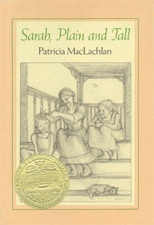
One of my favorite novels is Sarah, Plain and Tall by Patricia MacLachlan, about a family that has lost its mother. The father invites a mail-order bride from Maine--Sarah--to come live with them in their prairie home.

A beautiful aspect of the book is how well it uses color: the sky, the water, the prairie grass. So I like how the ending of the book uses color, too:

Autumn will come, then winter, cold with a wind that blows like the wind off the sea in Maine. There will be nests of curls to look for, and dried flowers all winter long. When there are storms, Papa will stretch a rope from the door to the barn so we will not be lost when we feed the sheep and the cows and Jack and Old Bess. And Sarah's chickens, if they aren't living in the house. There will be Sarah's sea, blue and gray and green, hanging on the wall. And songs, old ones and new. And Seal with yellow eyes. And there will be Sarah, plain and tall.

This book ends happily, with the story wrapped up. (I won't tell exactly what happens!) But there's also the question of how Sarah, who is from near the sea, will fit into this prairie family.

Luckily there are three sequels: Skylark, Caleb's Story, and More Perfect Than the Moon.

Monday, January 3, 2011

Openings


Happy New Year! I wish you all a great year of writing, discovering, and creating.

With the start of a new year, it seems fitting to talk about openings. I just started reading The Subtle Knife, the second book in Philip Pullman's trilogy His Dark Materials. Here's the opening to The Subtle Knife:

Will tugged at his mother's hand and said, "Come on, come on..."

But his mother hung back. She was still afraid. Will looked up and down the narrow street in the evening light, along the little terrace of houses, each behind its tiny garden and its box hedge, with the sun glaring off the windows of one side and leaving the other in shadow. There wasn't much time. People would be having their meal about now, and soon there would be other children around, to stare and comment and notice. It was dangerous to wait, but all he could do was persuade her, as usual.

"Mum, let's go in and see Mrs. Cooper," he said. "Look, we're nearly there."

"Mrs. Cooper?" she said doubtfully.

But he was already ringing the bell. He had to put down the bag to do it, because his other hand still held his mother's. It might have bothered him at twelve years of age to be seen holding his mother's hand, but he knew what would happen to her if he didn't.

Could you stop reading a novel with an opening that great? I couldn't! I want to know exactly what will happen to Will. In that short passage, Philip Pullman has told us that Will is 12 years old, his mother has something wrong with her, he's in danger, and he's running out of time.

As if that isn't enough, Pullman slips in a hint about the theme of the trilogy, Light vs. Darkness, in this wonderful description: with the sun glaring off the windows of one side and leaving the other in shadow.

I want to drop everything and read!

How about your own openings? Do you give your reader information (Will is 12 and his mother has something wrong with her), a problem (Will is in danger), tension (he's running out of time), and a hint about the theme (sun vs. shadow/light vs. darkness)? Few of us are masters like Philip Pullman, but we can still work on our openings.

Try writing an opening scene. Introduce your main character, a problem, and tension. (At this point you probably don't know what your theme will be; writers usually work in hints about theme in later revisions.)

Have fun "opening" the new year with a great opening!


Tuesday, December 21, 2010

Making a List, Checking It Twice


Most of us like to make lists, especially at this time of year. A great way to make a list and write a poem at the same time is to make a List Poem.

It's as simple as it sounds: you can make a poem out of a list of things, ideas, sounds, smells, favorite words. You can think of a theme and make a list that relates to the theme.

That's what Eileen Spinelli did in her poem, "Creativity," in Falling Down the Pages: A Book of List Poems (published by Roaring Brook Press).

"Creativity"

An artist takes:

colored pencil
piece of yarn
wooden slat from
some old barn
sidewalk chalk
or spool of wire
can of paint
or junkyard tire
twig or twine
or river rock
seed or seashell
woolen sock
bar of soap
or paper heart
and turns it
happily
to art.

Perhaps you have:
a shard of plate
a hinge from someone's
garden gate
a scrap of quilt
or rusty screw...

then you can be
an artist too.

A List Poem doesn't have to rhyme. "Walking Home from School I See" by Rebecca Kai Dotlich (from the same book) rhymes only in the last line:

"Walking Home from School I See"

A bus with a flat tire.
Pennies in a puddle.
Baby birds.
Fat worms.
A pair of pigeons.
A crooked gate.
A mailbox spray-painted pink.
A bulldog wearing a raincoat.
A bumblebee.
A reflection
in a window--
me!

Have a great time making lists and turning them into poems! With thanks to my writer friend George Shannon for giving me the book Falling Down the Pages.


Tuesday, December 7, 2010

Perspective


The dictionary defines perspective as, "A particular attitude toward or way of regarding something; a point of view." In other words, it's all about how you look at things.

I took a photo of these awesome Douglas firs at Camp Yeomalt Park near my house. I happened to look up, and saw how the perspective of the trees was different from what I was used to. Although I'd walked past these trees dozens of times, I saw them in a new way. I had a new point of view.

Having a new perspective on an object that you see everyday can help your writing. It helps because you're learning how to really see, not simply walk past an object (or tree) because--ho, hum--it's part of your background.

Try this exercise on perspective. Find an object in your house that you see nearly everyday. Now change your perspective of it. If it's your refrigerator, lie on the floor and look up at it. If it's your baby photo, tip it upside down. If it's your toothbrush, hold it by the wrong end. If it's your kitchen clock on the wall, pull up a chair next to it (with an adult's permission) and look at it from an inch away.

What new things can you notice about everyday objects? That's the fresh perspective, or point of view, we want to bring to our writing.

Have fun looking at objects. And don't forget to look up at the trees.


Monday, November 29, 2010

Write a Magazine Poem


A very fun way to write a poem is to use magazines. Here's what you do:

First, find one or two magazines (make sure everyone is done reading them first).

Second, get a pair of scissors (ask an adult for help if you need it).

Third, flip through the pages of the magazines, and cut sentences out at random.

Okay, now you should have a pile of cut-out sentences or phrases. The more the better!

On a sheet of paper or in your writing journal, try arranging your sentences. Pick out the ones you like--the words, a phrase, or the meaning. Recycle the ones you don't like. Can you see a theme? Does one of the sentences make a good title? Is your poem silly or serious? Is it nonsensical? Does it rhyme? (It doesn't have to!)

After you arrange the cut-out sentences to form a poem you like, glue them onto the paper. Congratulations! You have written a magazine poem!


Monday, November 8, 2010

A Rose Is A Rose...


I teach a class for adults called "Creativity for Writers." In this class, I encourage my students to have a "creativity date" each week.

What is a creativity date? It's one half hour you spend by yourself, either writing, drawing, listening to music, or doing something else creative. It's important that you do your creativity date by yourself. Why? When we're with our family and friends, we enjoy talking to them and goofing around. Nothing wrong with that. But when we're by ourselves and open to ideas, that's when the creative bug is most likely to bite.

Last week I went on a creativity date by myself. I biked to a neighborhood pond with my notebook. It's my creativity notebook, which has big white pages and no lines. I also brought a box of colored pencils.

I saw this flower and decided to draw it. I looked at the flower carefully and put in as much detail as I could. When I finished, I thought I had included a lot of detail. Then I took a photo of the flower. When I saw the photo, I was shocked. I missed a lot of details, like the little dots on the leaves and the way the sun hit the red petals.

If you have access to a camera, try this. Choose something to draw and look at it carefully. After drawing it, take a photo and compare the photo to your drawing. Did you miss anything? Try drawing it again, only this time include the details you missed.

Drawing and taking photos are great ways for writers to learn to look carefully!


Monday, November 1, 2010

The Numbers Game


This writing exercise is adapted from the book Drawing Lab for Mixed-Media Artists: 52 Creative Exercises to Make Drawing Fun, by Carla Sondheim, published by Quarry Books.

What does writing have to do with drawing? Everything! Whether we write or draw (or both), we're expressing our creativity. Many drawing exercises can be used for writing. "The Numbers Game" is one of them. This one you can do with a friend.

Ask a friend to take a sheet of paper and fold it in half lengthwise. On the left side of the paper, ask your friend to list 10 animals down the page and number them 1 to 10. On the right side of the paper, ask your friend to list 10 objects and number them 1 to 10. Don't let your friend show you what he or she has written.

For example:

On the left:

  1. giraffe
  2. buffalo
  3. mosquito
  4. seagull
  5. beetle
  6. gorilla
  7. panda
  8. rat
  9. raccoon
  10. coyote
On the right:
  1. star
  2. scissors
  3. rainbow
  4. flag
  5. broccoli
  6. bus
  7. mirror
  8. computer
  9. stapler
  10. pizza
Without looking at the list your friend made, pick two numbers from 1 to 10. Now (finally!) you get to look at the list. What two objects did you pick?

Let's say you picked 6 and 9: a gorilla and a stapler. Write a story about a gorilla and a stapler. Maybe a gorilla goes out shopping for bananas, but comes home with a stapler. What is a gorilla going to do with a stapler?? What if you picked 5 and 10? A beetle and a pizza. 1 and 7? A giraffe and a mirror.

Before you write your story, switch roles with your friend. Just as your friend did, take a sheet of paper, make two lists, and ask your friend to pick two numbers. When you have both chosen an animal and an object, sit down together and each write your own story. Have fun being as creative as you can!

When you're done, read your stories out loud to each other.

For extra fun, combine your two animals and your two objects, and write a story together. Maybe it will be a gorilla, a stapler, an ox, and an umbrella. Write a story together with those four things in it.

If you want, illustrate your story after you are finished. See? Drawing and writing go together!